Bitcoin Perps Explained: BTCUSDT Perpetual Futures, Funding Rates, and Self-Custody

Bitcoin’s spot market gets most of the public attention, but a huge part of BTC trading activity happens somewhere else: perpetual futures.
That’s where traders use leverage, build short-term positions, hedge exposure, and react to volatility around the clock. In practice, Bitcoin perps became the market’s positioning layer. Spot BTC reflects ownership. BTCUSDT perpetual futures reflect conviction, pressure, and speculation happening in real time.
This is also why metrics like funding rates, open interest, and trading volume matter so much in crypto futures. They reveal how traders are positioned beneath the price itself.
And now another shift is starting to reshape the market. Bitcoin perps were historically dominated by centralized exchanges, but self-custodial trading systems like Hyperliquid are beginning to move perpetual futures into wallet-based environments.
Why Bitcoin Perps Became the Core of Crypto Futures Trading
Bitcoin perps became the center of crypto futures because BTC has the deepest liquidity, strongest market recognition, and constant global trading demand. For active traders, BTCUSDT perpetual futures offer leverage, short exposure, and faster positioning than spot markets.
Bitcoin was the first crypto asset to develop deep perpetual futures liquidity at scale, and it still anchors much of the market today.
Most major trading venues use BTCUSDT perpetual futures as one of their primary markets because Bitcoin combines liquidity, volatility, and constant global participation. When traders want exposure to crypto momentum, BTC perps are usually where they start.
Perpetual futures also fit Bitcoin’s trading behavior better than traditional futures contracts. There is no expiry date, positions can stay open continuously, and traders can move long or short without waiting for settlement cycles.
That structure turned Bitcoin perps into the default market for active trading:
- leverage became easier to access
- liquidity concentrated around BTC pairs
- funding rates created continuous positioning signals
- futures trading volume often exceeded spot activity during volatile periods
Over time, BTCUSDT perpetual futures evolved beyond a simple derivative product. They became one of the main ways traders express short-term views on Bitcoin itself.
What Are Bitcoin Perps?
Bitcoin perps are perpetual futures contracts that let traders take long or short exposure to BTC without owning Bitcoin directly. They have no expiry date, use margin, and are designed for active crypto futures trading.
Bitcoin perps, short for Bitcoin perpetual futures, are contracts that allow traders to speculate on BTC price movements without owning Bitcoin directly.
Unlike traditional futures, they do not expire. A trader can hold a long or short position indefinitely as long as margin requirements are maintained.
This makes perps highly flexible for active trading. Instead of buying spot BTC and waiting for price appreciation, traders can:
- trade both upward and downward moves
- use leverage
- hedge existing BTC exposure
- react quickly to short-term volatility
The most common market format is BTCUSDT perpetual futures, where Bitcoin exposure is traded against a stablecoin pair.
Because these contracts stay open continuously, perpetual futures markets need mechanisms like funding rates and mark pricing to keep perp prices aligned with the underlying spot market.
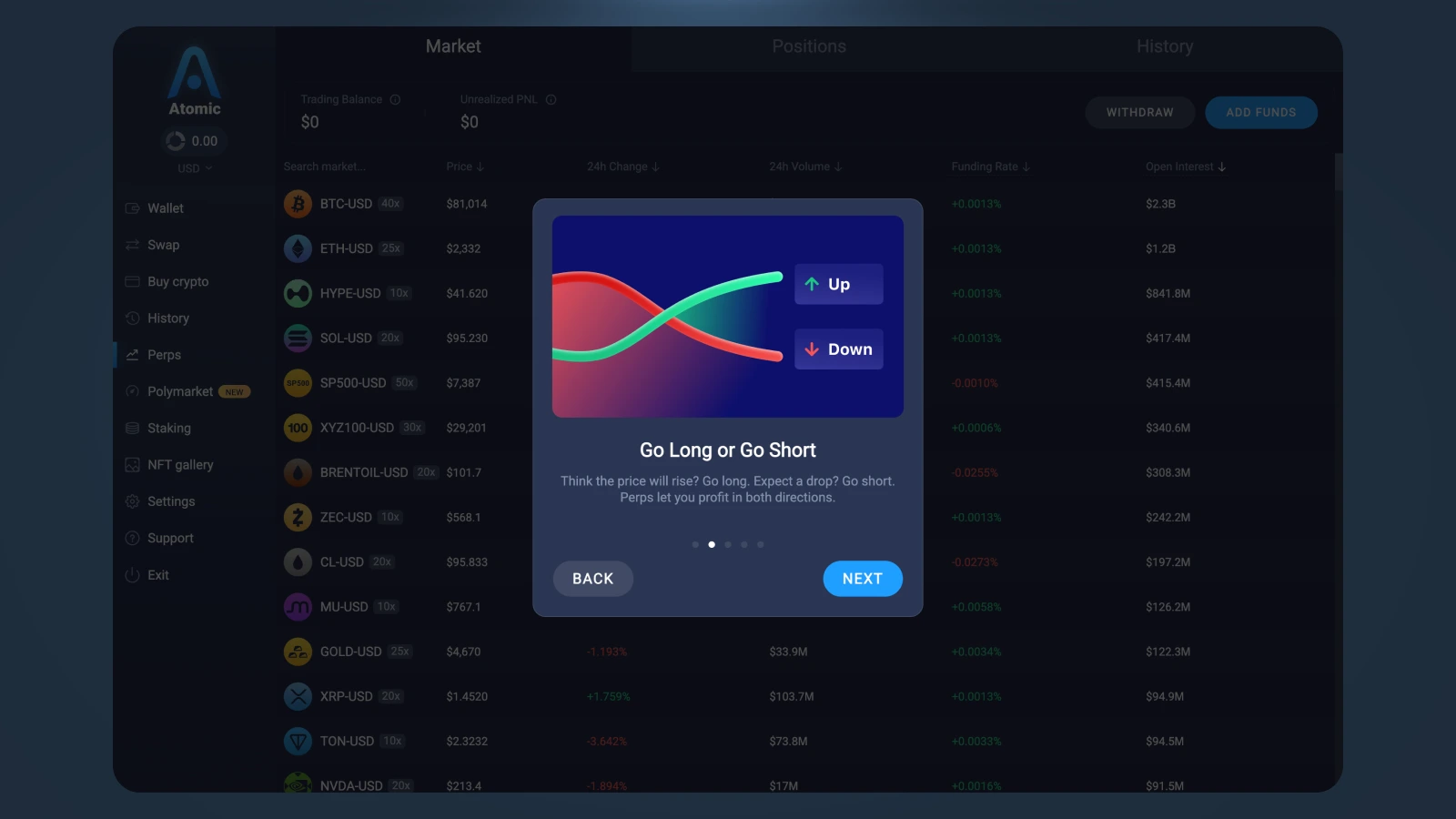
How BTCUSDT Perpetual Futures Pricing Works
BTCUSDT perpetual futures closely follow Bitcoin’s spot price, but leverage, trader positioning, and futures market demand can temporarily push perp prices above or below spot. Funding rates and mark pricing help keep the two markets aligned over time.
BTCUSDT perpetual futures are designed to track the spot price of Bitcoin closely, but the two prices are never perfectly identical.
Perp markets move according to trader positioning, leverage demand, and liquidity inside the futures market itself. During aggressive buying or selling, perpetual prices can drift above or below spot BTC.
That is why perpetual futures rely on additional pricing mechanisms:
- index price tracks the underlying spot market across major exchanges
- mark price is used to calculate unrealized PnL and liquidation thresholds
- funding rates help pull perpetual pricing back toward spot over time
These systems work together to prevent perpetual futures from separating too far from the real Bitcoin market.
The relationship becomes especially important during volatile periods. A rapid increase in leveraged longs can push BTCUSDT perpetual futures above spot, while heavy short pressure can pull them below it. Funding then adjusts to create incentives for the imbalance to normalize.
Why Funding Rates Matter in Bitcoin Perps
Funding rates help traders understand market imbalance inside Bitcoin perps. They show whether longs or shorts are paying to maintain positions, making them one of the clearest signals for leverage pressure and crowded positioning.
Funding rates are one of the clearest ways to read positioning pressure in Bitcoin perpetual futures.
They are not trading fees in the traditional sense. Funding is a periodic payment exchanged between longs and shorts depending on which side of the market becomes dominant.
When funding turns strongly positive:
- long positioning is crowded
- traders are paying to maintain bullish exposure
- perp prices often trade above spot
When funding turns deeply negative:
- short positioning dominates
- traders are paying to stay bearish
- perp prices often trade below spot
This is why Bitcoin funding rates matter far beyond the payment itself. They reveal how aggressively traders are leaning in one direction.
Extreme funding does not automatically mean the market will reverse, but it often signals that leverage and conviction are becoming concentrated on one side of the trade.
Bitcoin Funding Rates, Open Interest, and Trading Volume
Funding rates, open interest, and trading volume each reveal different layers of the Bitcoin perp market. Together, they help traders understand positioning, leverage buildup, and whether momentum is being driven by fresh exposure or short-term activity.
Funding rates become much more useful when combined with open interest and trading volume instead of viewed in isolation.
Each metric reveals a different layer of the Bitcoin perp market:
The real insight comes from how these metrics move together.
- Rising open interest + rising funding
→ new leveraged positions are building aggressively on one side of the market - High trading volume + neutral funding
→ heavy activity without extreme directional imbalance - Falling open interest during volatility
→ positions are unwinding, often through profit-taking or liquidations - Extreme funding + rapidly rising volume
→ speculative pressure is accelerating and the market may become unstable
This is why perp traders rarely watch BTC price alone. Positioning metrics often reveal stress building underneath the move before it becomes obvious on the chart.
Why Bitcoin Perps Dominate Futures Trading
Bitcoin perps dominate crypto futures because BTC remains the market’s most liquid and actively traded asset. Deep liquidity, continuous volatility, and global participation turned BTCUSDT perpetual futures into the primary venue for leveraged crypto trading.
Bitcoin perps became the center of crypto futures trading because no other market combines liquidity, leverage, and global participation at the same scale.
BTC trades continuously across regions, reacts instantly to macro events, and serves as the benchmark asset for much of the crypto market. When volatility enters crypto, Bitcoin perpetual futures usually absorb the first wave of positioning.
That concentration creates a feedback loop:
- liquidity attracts traders
- traders increase trading volume
- deeper volume attracts larger positions
- larger positions amplify the importance of funding and open interest
Institutional activity also reinforced Bitcoin’s dominance in futures markets. BTC perpetuals became the primary venue for hedging, directional trading, and short-term speculation across the industry.
Over time, Bitcoin perps evolved into more than a leveraged BTC product. They became one of the market’s main engines for price discovery and sentiment formation.
Bitcoin Perps vs Spot Bitcoin
Spot Bitcoin is built around ownership, while Bitcoin perps are built around leveraged exposure and active trading. Both track BTC, but they serve different roles in the market and behave differently during volatility.
Spot Bitcoin and Bitcoin perps may track the same asset, but traders use them for very different purposes.
Spot BTC is centered around ownership. Perpetual futures are centered around exposure and positioning.
This difference is why perp markets often react faster during volatility. Leverage amplifies positioning pressure, liquidations accelerate moves, and funding rates continuously adjust based on market imbalance.
For many traders, spot BTC represents long-term exposure. Bitcoin perps represent active participation in short-term market movement.
What Self-Custody Changes in Bitcoin Perps
Self-custodial perps shift control away from centralized exchange accounts and toward wallet-based trading systems. That changes how traders manage collateral, access markets, and think about counterparty risk inside crypto futures trading.
For most of crypto’s history, serious perpetual futures trading existed almost entirely on centralized exchanges.
That structure made sense. Perps require fast execution, constant collateral management, liquidation systems, and deep liquidity — all things centralized trading infrastructure handled well for years.
What is changing now is the custody layer underneath the trade.
Platforms like Hyperliquid are pushing Bitcoin perps into self-custodial environments where traders access markets through wallets rather than relying fully on exchange-held accounts. The goal is not to remove active trading mechanics, but to separate those mechanics from centralized custody.
That shift matters because it changes how traders think about exposure:
- wallet access replaces traditional account structures
- collateral becomes more directly user-controlled
- dependence on centralized custody decreases
- futures trading moves closer to on-chain infrastructure
Bitcoin perps are no longer only about leverage and speculation. They are becoming part of the broader evolution toward self-custodial trading systems.
What Is Hyperliquid and Why Traders Watch It
Hyperliquid is closely watched because it pushes Bitcoin perps toward faster, wallet-based futures trading. Its focus on order books, on-chain execution, and self-custody makes it one of the clearest examples of where crypto futures infrastructure is moving.
Hyperliquid became one of the most closely watched platforms in crypto perps because it approached futures trading differently from traditional DeFi systems.
Instead of building around AMMs and swap mechanics, it focused on order-book trading and execution speed — the parts of the experience active traders actually care about.
That matters in Bitcoin perps because BTC futures trading is highly sensitive to liquidity, latency, and positioning pressure. Traders are used to centralized exchanges delivering that environment, which is why self-custodial alternatives struggled for years.
Hyperliquid changed the conversation by attempting to combine:
- perpetual futures trading
- wallet-based access
- on-chain execution
- CEX-style trading flow
It is not important because it is “another DEX.” It matters because it represents a broader shift toward self-custodial futures infrastructure that can realistically compete for active trading volume.
Accessing Bitcoin Perpetual Futures Markets
As Bitcoin perps grow, access matters as much as mechanics. Traders need platforms that make BTCUSDT perpetual futures usable, liquid, and manageable without adding unnecessary friction to an already fast-moving market.
As Bitcoin perps continue growing, the challenge for many users is no longer understanding leverage — it is finding the right way to access these markets.
Some traders want infrastructure-heavy environments with advanced order-book systems and deep customization. Others want a simpler route into perpetual futures without turning trading into a full-time infrastructure problem.
That is where access layers become important.
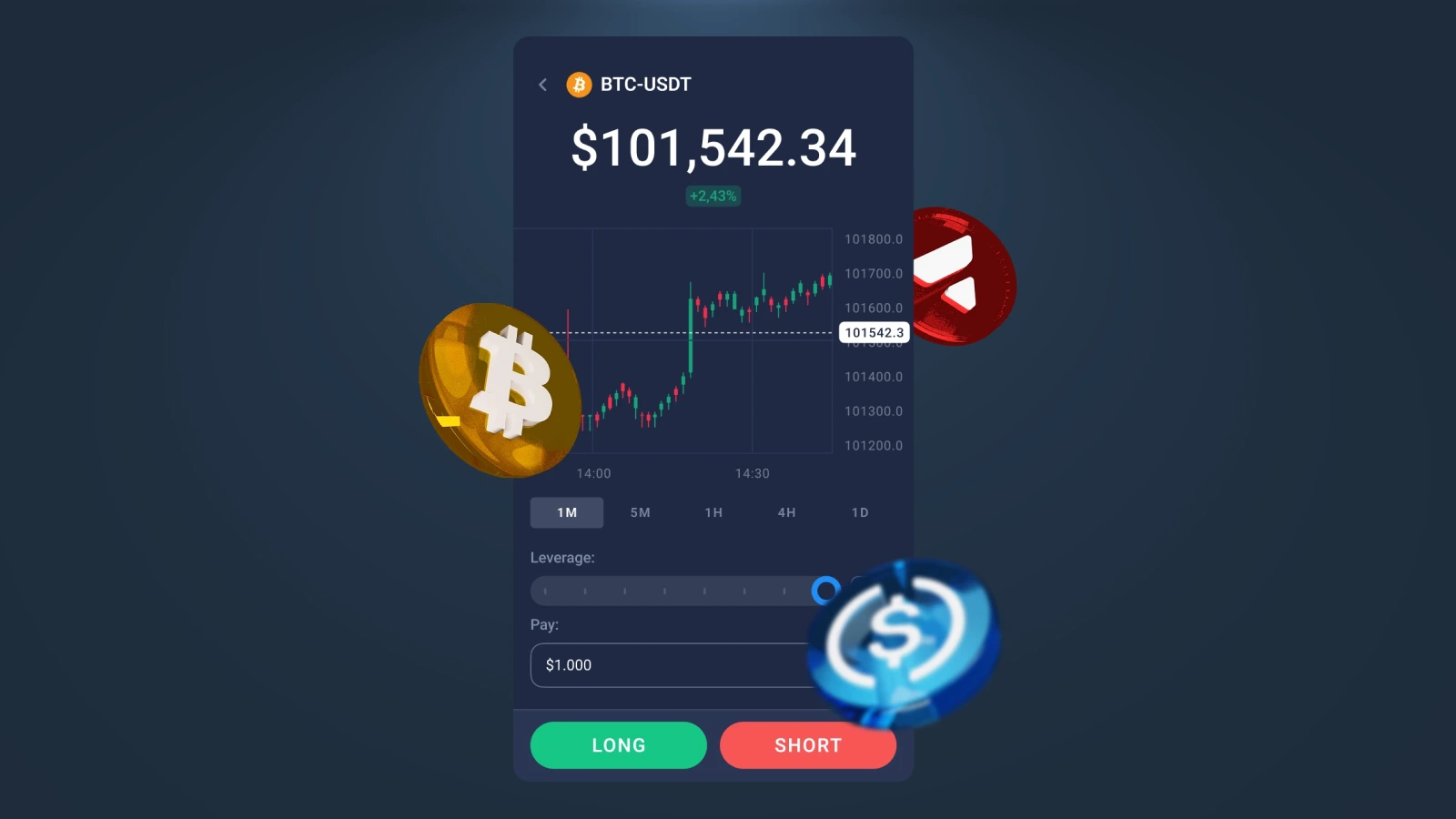
Platforms like Hyperliquid push self-custodial trading infrastructure forward, while products such as Atomic Wallet’s Perps trading focus on making Bitcoin perpetual futures easier to access and manage for a broader range of users.
The market is gradually moving toward a model where traders expect both: active futures trading and more direct control over how they access it.
Conclusion: Bitcoin Perps as the Market’s Positioning Layer
Bitcoin perps became the market’s primary positioning layer for short-term BTC sentiment. Funding rates, open interest, and trading volume now help traders read leverage, conviction, and pressure building underneath Bitcoin price action.
Bitcoin perpetual futures evolved far beyond a simple leveraged trading product.
Today, BTC perps act as one of the market’s main positioning layers. Funding rates reveal imbalance, open interest shows exposure building in real time, and trading volume reflects how aggressively traders are participating beneath the price itself.
That is why BTCUSDT perpetual futures became central to crypto futures trading. They are where short-term conviction, leverage, and market pressure converge.
At the same time, another transition is beginning to reshape this space. Perpetual trading is gradually moving beyond fully centralized custody toward wallet-based systems and self-custodial infrastructure.
Bitcoin perps are no longer only a way to speculate on BTC. They are becoming part of a broader shift in how crypto trading itself is structured.