Klarna Launches KlarnaUSD: The New Stablecoin on Tempo Blockchain

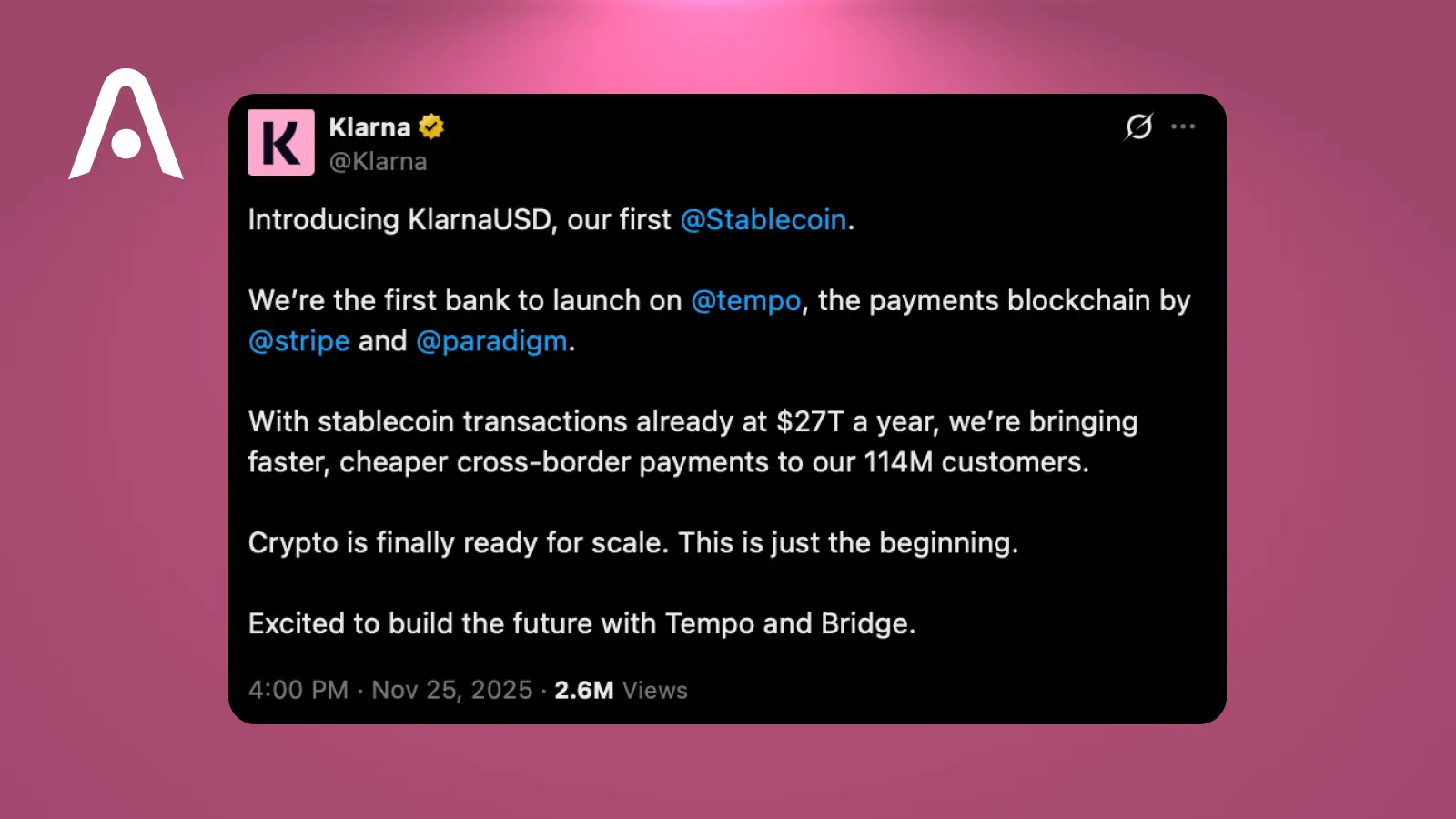
Klarna just made one of its biggest strategic shifts yet: the fintech giant is launching its own U.S. dollar stablecoin called KlarnaUSD. After years of relying on traditional rails like SWIFT and correspondent banks, Klarna is now moving core payments onto Tempo — a new blockchain built by Stripe and Paradigm specifically for global money movement.
This isn’t just another corporate experiment with crypto. Klarna is preparing to bring blockchain-level speed and efficiency to its 114 million customers, positioning KlarnaUSD as the next-generation alternative to slow, expensive cross-border transfers.
What Is KlarnaUSD?
KlarnaUSD is Klarna’s upcoming USD-backed stablecoin, engineered for fast and cheap global transactions. It will run on Tempo, a compliance-first payments chain designed to scale fintech traffic and integrate directly with payment processors like Stripe.
The goal is simple: replace slow legacy infrastructure with instant, low-fee transfers that work natively inside the Klarna app — without users having to understand anything about crypto. KlarnaUSD is set to launch on mainnet in 2026 through Stripe’s Bridge platform, making it fully compliant and accessible from day one.
Why Klarna Is Launching a Stablecoin
Klarna has spent years depending on traditional rails like SWIFT and card networks — systems that are slow, expensive, and poorly suited for global micro-payments. Meanwhile, stablecoin settlement has exploded to over $27T annually, proving that crypto rails already outperform legacy infrastructure at scale.
KlarnaUSD is their answer to this gap. A stablecoin lets Klarna bypass slow intermediaries, settle across borders instantly, and dramatically reduce the cost of moving money. For a company operating in dozens of countries, shifting even a fraction of its volume to blockchain is a direct efficiency upgrade — and a competitive edge over other fintechs still tied to old systems.
Tempo Blockchain — Why Klarna Chose It
Tempo isn’t a typical Layer-1. It’s a purpose-built payments chain created by Stripe and Paradigm, designed to meet banking-grade compliance while delivering near-instant settlement. Klarna can issue a fully regulated stablecoin, integrate with fiat onramps, and run global transfers without touching high-friction crypto infrastructure.
A key part of this setup is Stripe’s Bridge platform — a compliance layer that lets institutions launch blockchain assets with proper oversight. For Klarna, Tempo offers a clean path to scaling stablecoin payments to millions of users without sacrificing regulatory readiness or user experience.
KlarnaUSD Features & How It Works
KlarnaUSD is built as a clean, utility-first stablecoin meant for real payments rather than speculation. It settles on Tempo with fast confirmation times and low fees, making it suitable for everyday transactions. For users, it integrates directly inside the Klarna app, so sending money feels no different from any other fintech transfer — just faster.
Key features include:
- Instant cross-border settlement
- Low-cost transfers with no SWIFT delays
- Native support inside Klarna’s 114M-user app
- Fully compliant issuance via Stripe’s Bridge
- Clear on/off-ramp paths through Klarna’s existing banking tools
Because the stablecoin is embedded into Klarna’s existing UX, most users may not even realize they’re using blockchain infrastructure — which is exactly the point.
KlarnaUSD vs Traditional Payments (SWIFT, Cards)
KlarnaUSD is fundamentally different from the systems fintechs typically rely on. SWIFT transfers can take days and involve multiple intermediaries, each adding fees and friction. Card networks settle slowly behind the scenes and require merchants to absorb high processing costs.
Tempo-based stablecoin transfers settle almost instantly and operate 24/7, with predictable low costs and no chains of intermediaries. For Klarna, this means faster merchant payouts, cheaper global transfers, and the ability to scale payment volume far beyond what legacy rails can support.
Why This Matters for 114M Klarna Users
For Klarna’s global user base, KlarnaUSD means faster, cheaper, and more predictable payments — especially across borders. Transfers that once required intermediaries or slow banking rails can move instantly inside the Klarna app, with no extra steps or crypto-specific complexity.
For merchants, faster settlement and lower processing costs make KlarnaUSD an attractive upgrade to the existing checkout flow. Users simply transact as usual, while the underlying rails become dramatically more efficient.
CEO Perspective — “Crypto Is Finally Ready for Scale”
Klarna’s CEO, Sebastian Siemiatkowski, was once skeptical of crypto, but now argues that stablecoins have reached a point where they can meaningfully improve global payments. His statement — that “crypto is finally ready for scale” — signals a strategic shift: not adopting crypto for hype, but for operational efficiency.
This pivot places Klarna among the first major fintechs to publicly acknowledge that blockchain infrastructure can outperform traditional rails at global scale.
What Klarna Plans Next (2026 Mainnet Launch)
KlarnaUSD is set to go live on Tempo mainnet in 2026 through Stripe’s Bridge platform, which handles full compliance and connectivity for financial institutions. This rollout will bring the stablecoin directly into Klarna’s core app experience, enabling everyday payments, merchant settlements, and cross-border transfers powered by blockchain.
Klarna also plans broader integrations across Visa, Mastercard, and existing bank partners, positioning KlarnaUSD as a seamless upgrade — not a separate “crypto product.” Users won’t need to manage wallets or understand blockchain mechanics; the app abstracts everything into familiar fintech UX.
Why KlarnaUSD Is a Big Deal for Fintech
Klarna’s move marks the first time a major global fintech launches its own stablecoin on an institutional-grade blockchain. It signals a turning point: traditional payment providers are no longer experimenting with crypto — they’re adopting it as core infrastructure.
If successful, KlarnaUSD could push other fintech giants toward stablecoins as the default for cross-border settlement, payroll, merchant payments, and user-to-user transfers. It’s a major validation of blockchain rails from a company processing billions annually.
Manage Your Crypto Safely With Atomic Wallet
Atomic Wallet helps you stay ready as fintech and blockchain converge. Store and manage stablecoins, swap between assets, and keep full control of your private keys — all in one non-custodial app. As new assets like KlarnaUSD enter the market, Atomic gives you a secure hub for managing your portfolio without relying on centralized platforms.
Whether you’re preparing for new stablecoin integrations or simply want a safer way to hold and exchange digital assets, Atomic Wallet keeps everything under your control