Most Profitable Crypto Mining in 2026: What to Mine and How to Calculate Profit
Crypto mining can still be profitable in 2026, but there is no universal “best coin” for every miner. Profit depends on the equipment you use, the price you pay for electricity, network difficulty, mining rewards, pool fees, cooling costs, and the market price of the coin you mine.
That is why outdated mining lists can be dangerous. A coin that looks profitable today can become unprofitable after a price drop, difficulty spike, hardware update, or reward change. The smarter approach is to compare coins by hardware type and calculate your real margin before buying equipment or joining a pool.
This guide breaks down how crypto mining works, what affects profitability, which coins miners are watching in 2026, and how to manage mining rewards safely after they arrive.
What Is Crypto Mining?
Crypto mining is the process used by Proof-of-Work blockchains to validate transactions and add new blocks to the network. Miners use computing power to solve cryptographic problems. When a miner or mining pool finds a valid block, the network rewards them with newly issued coins and, in some cases, transaction fees.
Mining is most closely associated with Bitcoin, but other Proof-of-Work networks also use miners to secure the chain. The exact hardware depends on the coin. Bitcoin mining is dominated by ASIC machines, while some smaller networks are still mined with GPUs or CPUs.
The key idea is simple: miners spend electricity and hardware resources to compete for rewards. If the value of those rewards is higher than the cost of mining, the operation can be profitable. If electricity, hardware, pool fees, or difficulty rise too much, mining can quickly turn into a loss.
Is Crypto Mining Still Profitable in 2026?
Yes, crypto mining can still be profitable in 2026, but mostly for miners who control their costs. Cheap electricity, efficient hardware, good cooling, and the right mining pool matter more than the coin name alone.
Bitcoin mining is still the largest and most competitive mining market, but it is difficult for casual miners because industrial operators use highly efficient ASIC fleets and negotiate low power rates. GPU mining can still work for some altcoins, but margins are usually thinner and change quickly. CPU mining is accessible, but it is often closer to hobby mining than a reliable income strategy.
For beginners, the safest answer is not “mine this coin.” It is “calculate first.” Before buying hardware, miners should check expected daily revenue, electricity cost, power draw, network difficulty, pool fees, and how long it may take to recover the equipment cost.
What Determines Mining Profitability?
Mining profitability is the difference between what your hardware earns and what it costs to run. The most important variables are practical, not theoretical.
- Electricity cost: usually the biggest operating expense. A miner with cheap power can stay profitable while another miner with the same machine loses money.
- Hardware efficiency: modern ASICs and efficient GPUs produce more hashpower per watt, which improves margins.
- Coin price: if the mined coin falls in price, mining revenue drops even if the machine produces the same number of coins.
- Network difficulty: as more miners join a network, rewards become harder to earn.
- Block rewards and fees: miners earn newly issued coins and sometimes transaction fees, depending on the network.
- Pool fees: mining pools charge a percentage of rewards in exchange for more predictable payouts.
- Cooling and maintenance: heat, noise, repairs, replacement parts, and downtime all affect real profit.
- Liquidity: a mined coin must be easy enough to sell, swap, or store safely.
- Taxes and local rules: mining income may be taxable, and some regions have restrictions on mining activity.
The most profitable crypto to mine is the one that works with your hardware and still leaves a margin after all costs. Without that calculation, a “profitable coin” is just a guess.
ASIC vs GPU vs CPU Mining
The first mining decision is hardware. Different coins use different algorithms, and not every machine can mine every network. An ASIC built for Bitcoin cannot suddenly become a flexible GPU rig, while a CPU setup will not compete with industrial Bitcoin miners.
ASIC mining is usually the strongest option when the machine, coin, and electricity price line up. GPU mining is more adaptable because miners can switch between coins as profitability changes. CPU mining is the easiest to start, but it is rarely the most profitable path unless the miner has a very specific setup and extremely low costs.
Most Profitable Crypto to Mine in 2026 by Hardware Type
There is no fixed ranking that works for every miner, so it is better to compare coins by hardware type. A Bitcoin ASIC miner, a GPU miner, and a CPU miner are not competing in the same market. They have different costs, algorithms, and profit windows.
Bitcoin (BTC): Best for Efficient ASIC Miners
Bitcoin remains the largest Proof-of-Work mining market, but it is also the most competitive. Mining BTC usually requires modern ASIC hardware, low electricity costs, strong cooling, and access to a reliable mining pool.
For large-scale operators, Bitcoin can still be attractive because it has deep liquidity and the strongest market recognition. For beginners, the challenge is cost. ASIC machines are expensive, power-hungry, and noisy, while mining difficulty adjusts as more hashpower joins the network. BTC mining can be profitable, but only when the numbers work after electricity, hardware depreciation, pool fees, and maintenance.
Kaspa (KAS): Popular ASIC Altcoin Mining Option
Kaspa has become one of the more watched ASIC mining alternatives outside Bitcoin. It attracts miners who want exposure to a newer Proof-of-Work network and are willing to take more market risk in exchange for potentially different reward dynamics.
The main appeal is that Kaspa mining can look attractive when hardware efficiency, coin price, and network difficulty align. The risk is that altcoin mining profitability can shift quickly. If difficulty rises or the market price weakens, margins can compress fast. KAS miners should check live profitability calculators before buying dedicated machines.
Litecoin and Dogecoin: Scrypt Merged Mining
Litecoin and Dogecoin are often discussed together because they can be merge-mined with Scrypt ASICs. This means miners can contribute hashpower to Litecoin and receive rewards connected to both LTC and DOGE without running two completely separate mining setups.
That makes the LTC/DOGE pair interesting for miners who already own Scrypt hardware. Litecoin brings a long market history, while Dogecoin adds liquidity, brand recognition, and a large trading community. Together, they can create a more balanced reward profile than mining only one Scrypt coin.
The risk is still profitability. Scrypt ASICs are specialized machines, and margins depend on hardware efficiency, electricity cost, pool terms, LTC price, DOGE price, and network difficulty. For new miners, buying hardware only because merged mining sounds efficient is not enough. The expected payout still needs to beat the full cost of running the machines.
Ethereum Classic (ETC): GPU and Etchash Mining Option
Ethereum Classic remains one of the better-known mining options after Ethereum moved to Proof of Stake. It uses the Etchash algorithm and is often considered by miners who still have GPU rigs from earlier cycles.
The appeal of ETC is familiarity. It has a longer history than many smaller GPU coins, trades on major exchanges, and gives GPU miners a clearer alternative to networks with weaker liquidity. For miners who already own equipment, ETC can be worth comparing against other GPU options.
The risk is that GPU mining margins are usually more fragile than ASIC mining. ETC profitability depends on coin price, network difficulty, GPU efficiency, electricity rates, and whether the miner already owns the hardware. If a miner has to buy new GPUs at high prices, the payback period can become difficult to justify.
Ravencoin (RVN): GPU Mining Classic
Ravencoin remains one of the classic GPU mining coins. It uses the KAWPOW algorithm and has long attracted miners who want a network designed around asset issuance, community mining, and resistance to ASIC dominance.
For GPU miners, RVN is useful because it gives them another option when profitability rotates away from ETC or other GPU coins. It can be mined with consumer graphics cards, and miners can switch in or out depending on electricity costs, network difficulty, and market price.
The risk is that Ravencoin’s profitability can be highly cyclical. RVN may look attractive during periods of strong altcoin demand, but margins can shrink quickly when price momentum fades or difficulty rises. It is better treated as a coin to compare in mining calculators, not a guaranteed long-term profit engine.
Ergo (ERG): GPU Mining Alternative
Ergo is another GPU mining option often watched by miners looking beyond the largest Proof-of-Work networks. Its appeal comes from a more research-driven blockchain design and a mining profile that can fit some GPU setups better than larger, more competitive coins.
For miners, ERG can be interesting when power efficiency matters. Some GPU rigs may perform better on Ergo than on other networks, depending on the cards, settings, and electricity price. That makes it worth checking alongside ETC, RVN, FLUX, and other GPU-mined coins.
The risk is liquidity and market demand. Smaller mining coins can be profitable on paper, but miners still need to sell, swap, or hold rewards in a market with enough depth. If trading volume is thin or price drops sharply, real profitability can be lower than calculator estimates.
Flux (FLUX): GPU Mining with an Infrastructure Narrative
Flux is another GPU-mined coin that miners often compare when looking for alternatives to ETC, RVN, and ERG. Its narrative is broader than simple mining rewards: the project is tied to decentralized infrastructure, cloud-style services, and distributed compute.
For GPU miners, FLUX can be attractive when its market price, network difficulty, and hardware performance line up. It also gives miners exposure to a project with a clearer infrastructure angle than many smaller Proof-of-Work coins.
The risk is the same as with most GPU-mined altcoins. Profitability can move quickly, and smaller markets are more sensitive to price swings. Miners should check whether FLUX rewards are worth the power draw, pool fees, and liquidity risk before switching rigs.
Monero (XMR): CPU Mining Option
Monero is one of the most recognized CPU-mining coins. It uses RandomX, an algorithm designed to make mining more accessible on general-purpose CPUs rather than pushing the network fully toward ASIC dominance.
For hobby miners, XMR is often one of the first coins to research because it does not require the same upfront hardware cost as ASIC mining. It can be useful for learning how mining works, testing a setup, or using existing CPU resources.
The risk is that CPU mining usually produces much lower revenue than ASIC or GPU mining. Monero also carries privacy-coin specific considerations, including exchange availability and regulatory pressure in some regions. For most users, XMR mining is better viewed as a low-barrier option to study and calculate carefully, not a guaranteed income stream.
How to Calculate Mining Profit Before You Start
Mining profit is not the same as mining revenue. Revenue is the value of the coins your hardware earns. Profit is what remains after electricity, pool fees, hardware costs, cooling, maintenance, and other expenses.
A simple way to think about it:
Mining profit = mining revenue - electricity cost - pool fees - hardware cost - cooling and maintenance
Before buying equipment, check these numbers with a live mining calculator. Tools like WhatToMine, ASIC Miner Value, MinerStat, and Hashrate Index can help compare expected revenue across coins, machines, hashrate, power draw, and electricity rates.
The most important input is electricity cost. A miner paying $0.04 per kWh and a miner paying $0.18 per kWh can get completely different results with the same machine. That is why two people can mine the same coin with the same hardware and only one of them stays profitable.
Hardware payback also matters. If a mining rig earns $5 per day after electricity but costs $2,000 to buy, the miner still needs to estimate how long it will take to recover that equipment cost. If profitability drops before the payback period ends, the real return may be much weaker than expected.
Mining Costs Beginners Forget
Beginners often calculate only the coin reward and electricity bill. Real mining costs are broader. Even a profitable setup on paper can underperform if heat, downtime, repairs, or poor liquidity are ignored.
Costs to include before starting:
- Power supply units, cables, shelves, and other setup equipment.
- Cooling, ventilation, fans, or air conditioning.
- Noise control, especially for home mining.
- Internet connection and monitoring tools.
- Pool fees and payout thresholds.
- Exchange fees, withdrawal fees, or swap costs.
- Hardware repairs and replacement parts.
- Downtime from outages, overheating, or failed components.
- Hardware depreciation and resale value.
- Taxes or reporting obligations in your country.
The better approach is to build a full cost model before mining. If the setup only looks profitable when you ignore cooling, hardware depreciation, or pool fees, the margin is probably too thin.
Solo Mining vs Pool Mining
Solo mining means trying to find blocks on your own. If you succeed, you keep the full block reward. The problem is variance. On large networks, a small solo miner may run hardware for a long time without finding a block, which makes income unpredictable and often unrealistic.
Pool mining is more practical for most miners. In a mining pool, many miners combine their hashpower and share rewards when the pool finds a block. Each participant receives a payout based on their contribution, minus the pool fee.
The trade-off is simple: solo mining offers full rewards but very low odds for small miners, while pool mining offers smaller but more regular payouts. For beginners, pool mining is usually the better starting point because it makes revenue easier to estimate.
Is Cloud Mining Profitable?
Cloud mining lets users rent mining power instead of buying and running hardware. On paper, it sounds simple: no machines, no heat, no noise, and no setup. In practice, cloud mining is one of the highest-risk areas of the mining market.
The main issue is that contracts often include hidden costs, maintenance fees, withdrawal limits, long lockups, or profitability assumptions that stop working when coin prices fall or difficulty rises. Some cloud mining offers are also outright scams, especially when they promise fixed or guaranteed returns.
Cloud mining can only make sense if the provider is transparent, the contract terms are clear, and the expected return still works after all fees. Beginners should be especially careful with any platform that advertises “guaranteed passive income” from mining. In crypto mining, returns are never guaranteed.
Mining vs Buying Crypto: Which Makes More Sense?
Mining is not the only way to get crypto exposure. For many beginners, buying crypto directly is simpler than purchasing hardware, setting up rigs, managing electricity costs, dealing with heat and noise, and waiting months to recover the equipment cost.
Mining makes more sense when you already have cheap electricity, efficient hardware, technical experience, and a realistic plan for selling or holding rewards. It can also appeal to users who want to support Proof-of-Work networks directly and are comfortable managing machines.
Buying crypto may make more sense if you want exposure without operational work. Instead of spending money on ASICs, GPUs, cooling, and maintenance, a user can buy BTC, LTC, DOGE, ETC, or other assets directly and store them in a secure wallet. This avoids mining complexity, but it still carries market risk because crypto prices can fall.
The choice depends on the goal. If you want to run infrastructure and calculate margins, mining can be worth studying. If you mainly want to hold crypto, buying may be more practical.
How Atomic Wallet Helps Manage Mining Rewards
Atomic Wallet is not mining software and does not run mining rigs. Its role comes after rewards are earned. Miners need a secure place to store, swap, and manage supported crypto assets instead of leaving everything on exchanges or pool payout accounts.
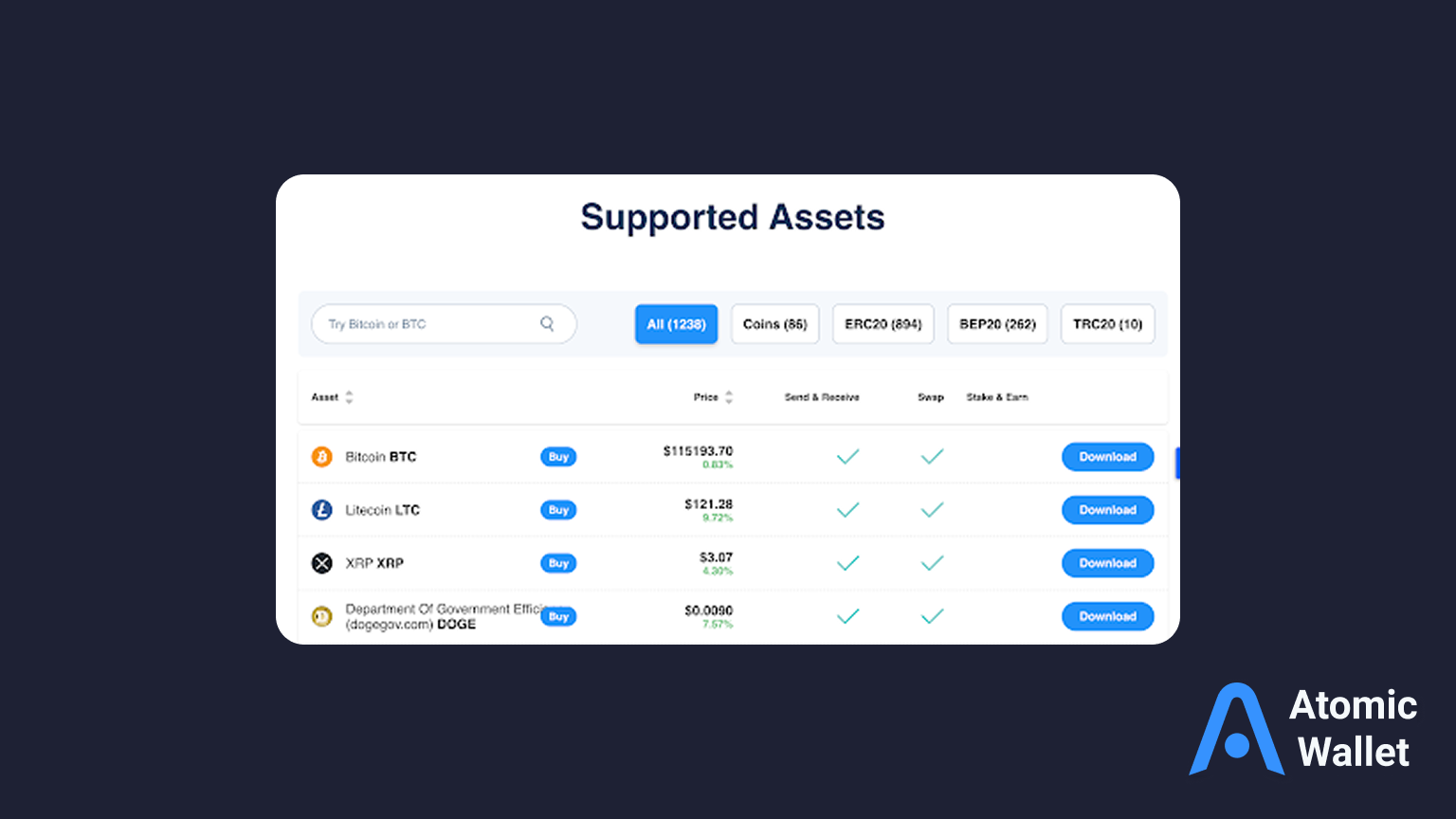
With Atomic Wallet, users can manage many supported assets in one self-custodial wallet. That can be useful for miners who receive rewards from different networks and want a simpler way to track balances, swap assets, or hold coins for longer periods.
Self-custody also matters. In Atomic Wallet, users control their recovery phrase and private keys, which means they are not relying on a centralized exchange to hold their mining rewards. The trade-off is responsibility: the recovery phrase must be stored offline and never shared.
Before sending mining rewards to any wallet, users should always confirm that the exact coin and network are supported. Some assets may have similar names or exist on multiple networks, so checking deposit details first can prevent costly mistakes.
Risks of Crypto Mining
Crypto mining can look attractive when coin prices are rising, but the risks are easy to underestimate. A miner is not only exposed to the coin’s price. They are also exposed to electricity costs, hardware performance, regulation, taxes, and operational issues.
The main risks include:
- High electricity costs that erase mining margins.
- Hardware depreciation as newer and more efficient machines enter the market.
- Market volatility that reduces the value of mined coins before they are sold.
- Network difficulty increases that lower expected rewards.
- Heat, noise, and maintenance problems, especially for home miners.
- Pool or payout issues if the mining pool changes terms or has reliability problems.
- Regulatory restrictions or tax obligations depending on the miner’s location.
- Cloud mining scams or contracts with unrealistic profit claims.
The biggest mistake is treating mining rewards as passive income. Mining is an active operation with changing costs and changing revenue. Profitability needs to be checked regularly, not only before the first machine is turned on.
Final Thoughts
The most profitable crypto to mine in 2026 depends on hardware, electricity, network difficulty, coin price, pool fees, and operating costs. There is no single coin that works for everyone.
Bitcoin can still make sense for efficient ASIC miners with cheap power. Kaspa, Litecoin and Dogecoin, Ethereum Classic, Ravencoin, Ergo, Flux, and Monero may fit different hardware setups, but each one needs a fresh profitability calculation before mining starts.
For beginners, the safest approach is to calculate first, start small, and avoid buying hardware based only on hype or outdated coin rankings. Use live mining calculators, include all real costs, and decide whether mining is actually better than simply buying crypto.
Once rewards arrive, storage matters too. A self-custodial wallet like Atomic Wallet can help users manage supported mining rewards, swap assets, and keep control of their private keys instead of leaving everything on an exchange.