What Is an Epoch in Crypto? Timing, Staking, and Rewards
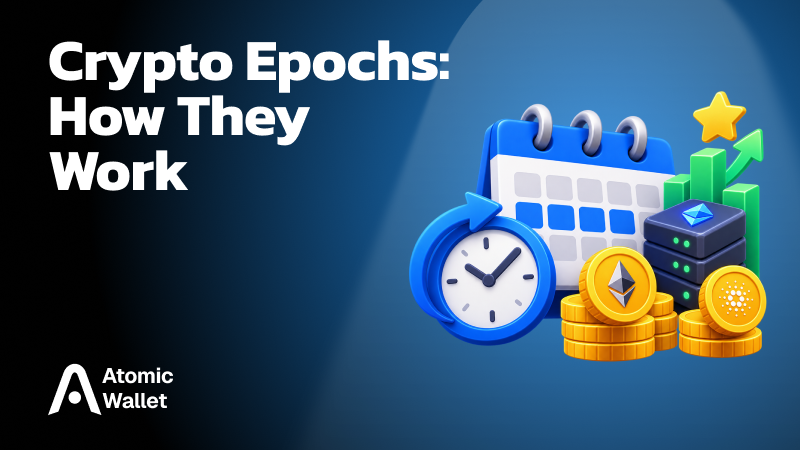
In crypto, an epoch is a recurring interval a blockchain uses to organize activities such as validator duties, staking calculations, and reward processing. Its length and purpose depend on the network.
You may encounter the term when checking staking rewards or waiting for a delegation to become active. Understanding the schedule helps explain those waits—but an epoch ending does not automatically mean your rewards have arrived or your funds are ready to withdraw.
What Is an Epoch in Crypto?
An epoch is a cycle defined by a blockchain’s protocol. Network participants follow its boundaries to coordinate specific tasks and account for activity over that period.
Depending on the blockchain, an epoch may contain a set number of slots or blocks. The protocol determines what happens during the cycle and which changes take effect when the next one begins.
There is no universal conversion from epochs to hours or days. Ethereum, Cardano, and Solana use different schedules, and even similarly sized epochs can serve different purposes. When a staking service quotes a waiting period in epochs, you need to identify the network and the operation involved.
The word also has meanings outside crypto. In machine learning, an epoch is one pass through a training dataset. The Unix epoch is a reference point for timestamps: January 1, 1970, at 00:00:00 UTC. In a blockchain staking interface, however, “epoch” generally refers to the network’s recurring operational cycle.
How Do Blockchain Epochs Work?
Epochs are used mainly by proof-of-stake (PoS) networks to coordinate validator duties, account for rewards and penalties, and schedule protocol changes.
What an epoch is used for depends on the blockchain:
- Assigning validator duties: Solana builds a stake-weighted leader schedule in advance for the entire epoch, determining which validator is scheduled to produce blocks in each slot. Ethereum reshuffles active validators into voting committees each epoch. These assignments distribute responsibilities across network participants.
- Reaching finality: On Ethereum, epoch boundaries define checkpoints that validators vote on. With sufficient support, checkpoints become justified and then finalized, securing the transaction history behind them. Finality requires validator agreement; the clock reaching a new epoch is not enough
- Calculating rewards and penalties: Epochs provide an accounting period for validator participation. On Ethereum, correct votes earn rewards, while missed duties can lead to penalties. More serious violations, such as conflicting votes or proposing two blocks for the same slot, can trigger slashing.
- Activating protocol updates: Epoch boundaries can provide a shared point for network participants to begin applying new rules. For example, Solana’s 200-millisecond slot target took effect at the start of epoch 1053 on October 9, 2026
A new epoch continues the existing blockchain. Balances and transaction history carry forward while the protocol updates the duties, calculations, or settings scheduled for that boundary.
Epoch vs Slot vs Block vs Snapshot
An epoch is a recurring cycle, a slot is an opportunity to produce a block, a block records activity, and a snapshot captures state at a particular moment.
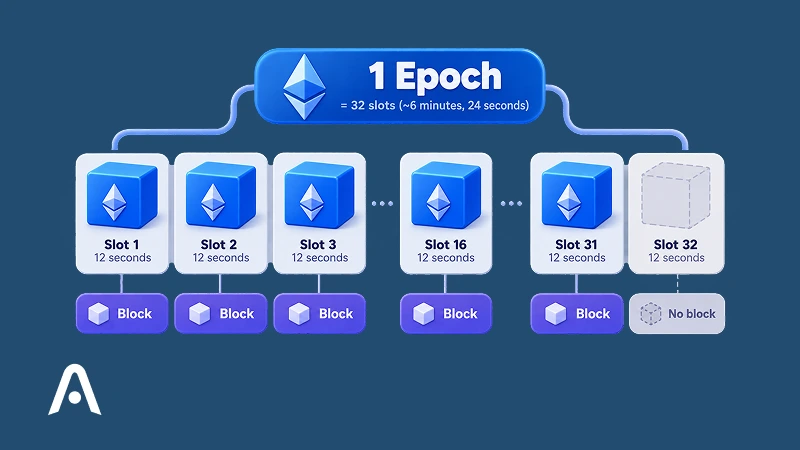
The distinction between slots and blocks matters. A slot can pass without a block being produced. Ethereum’s epoch still ends after its scheduled 32 slots, even if some were empty; it does not extend until 32 blocks have appeared.
A snapshot serves a different purpose. It fixes the information used for a particular calculation, rather than describing how long that calculation or reward cycle takes. On Cardano, for example, stake snapshots allow the network to use a defined distribution of delegations while wallet balances continue to change.
How Long Is a Solana Epoch?
A Solana epoch contains 432,000 slots and targets about 24 hours at 200 milliseconds per slot.
The 200-millisecond target took effect on October 9, 2026, at the start of epoch 1053. Before the staged slot-time reductions, the 400-millisecond target put an epoch at roughly two days. The number of slots per epoch stayed the same.
Actual duration can exceed the target. Epoch 1053, the first full epoch under the new setting, lasted approximately 26.2 hours, averaging 218.3 milliseconds per slot. Treat 24 hours as the target duration and check an explorer for the current estimate.
How Long Is a Cardano Epoch?
A Cardano epoch lasts five days and contains 432,000 slots of one second each.
This slot structure has been in place since the Shelley hard fork on July 29, 2020.
During the earlier Byron era, an epoch contained 21,600 slots of 20 seconds each. The total duration was still five days: Shelley changed the slot length and count while preserving the epoch’s overall length.
How Long Is an Ethereum Epoch?
An Ethereum epoch lasts 6.4 minutes, or 6 minutes and 24 seconds: 32 slots of 12 seconds each.
Epoch boundaries define checkpoints used in Ethereum’s finality process. Under normal conditions, a checkpoint takes two epochs—approximately 12.8 minutes—to become finalized, with votes representing at least two-thirds of the active stake required.
That does not give every new block an identical 12.8-minute countdown. Its position within the epoch affects the wait, and insufficient validator participation can delay finality. An epoch boundary alone does not make a block final.
How Epochs Affect Staking and Rewards
Epochs help determine when stake becomes eligible to earn rewards and which activity those rewards cover. A confirmed staking transaction can come before activation, calculation, and payment.
When checking your staking status, distinguish these stages:
- Confirmation: Your staking or delegation transaction has been recorded
- Activation: Your stake becomes eligible to participate under the network’s rules
- Calculation: The protocol determines rewards using eligible stake, validator performance, and other applicable factors
- Distribution: Rewards are credited to the relevant account or reward balance
On Cardano, your first staking reward usually arrives 15–20 days after delegation, depending on when you delegate within the epoch and whether your pool earns rewards. After that initial wait, eligible rewards are credited every epoch - once every five days. The first payment takes longer because your delegation must pass through the snapshot, activation, and reward-processing stages.
Epochs and Unstaking: When Can You Access Your Crypto?
Your crypto becomes available according to the network’s withdrawal rules and your staking account’s status. An epoch ending does not automatically release staked funds.
The process differs across networks:
- Cardano: ADA delegated through native staking remains spendable. You can send it without waiting for the five-day epoch to finish or completing an unstaking cooldown.
- Solana: Active stake must go through deactivation before it can be withdrawn. Changes take effect at epoch boundaries, and network-wide limits can extend the process across multiple epochs. Once the relevant stake is inactive, it can be withdrawn from the stake account to your wallet.
- Ethereum: A standard validator exit has three stages: the exit queue, a fixed withdrawability delay, and withdrawal processing. After the validator’s scheduled exit, it must wait 256 epochs (approximately 27.3 hours) before becoming eligible for withdrawal. The exit queue comes before that delay; the withdrawal sweep comes afterward. Those 27.3 hours therefore do not represent the total unstaking time.
Before planning a transfer, check the available balance and the status of the specific staking position. A confirmed unstaking request shows that your instruction was recorded; the funds may still be completing the required waiting period.
How Long Does It Take to Unstake Solana?
Native Solana unstaking normally completes at the next epoch boundary, often within a few hours to roughly a day, provided network-wide cooldown demand stays within the available allowance.
The wait depends on when your deactivation transaction confirms. A request confirmed near the end of an epoch can finish much sooner than one confirmed just after it begins. Since October 2026, Solana has targeted roughly 24-hour epochs; actual durations can be longer. Older estimates of two to three days reflect the previous timing.
The network’s cooldown allowance is 9% of the previous epoch’s total effective stake. If deactivation demand exceeds that allowance, the available capacity is shared proportionally, and completing your unstake can take multiple epochs. This is a network-wide limit, rather than a 9% limit on your individual position.
Once your stake becomes inactive, withdraw the available SOL from the stake account to your wallet.
If you already hold a liquid staking token such as JitoSOL or mSOL, you can instead swap it for SOL without waiting for native deactivation, subject to available liquidity. The trade can involve fees, slippage, or a discount to the token’s underlying value.
How to Check the Current Epoch
Use a blockchain explorer to check the network’s current epoch, then inspect your staking position to see which stage applies to your funds.
You can do this without running a node or writing code:
- Open an explorer for the correct network: Examples include Solana Explorer, Cexplorer for Cardano, and Beaconcha.in for Ethereum
- Find the epoch information: Look for the current epoch number, progress, and remaining time where displayed
- Inspect your staking position: Search using the appropriate public identifier, such as a Solana stake account address, a Cardano stake address, or an Ethereum validator index
- Check the relevant status: Review activation, deactivation, reward history, or withdrawal eligibility according to the operation you are tracking
For Solana, use the stake account address associated with your delegation. It is separate from your ordinary wallet address, and its explorer page provides information about that staking position.
Read countdowns as estimates of the next network boundary. “Two hours remaining” does not necessarily mean your rewards or withdrawal will arrive in two hours. \
Viewing public explorer data requires no wallet connection, recovery phrase, or private key.
Manage Your Staking With Atomic Wallet
You can stake SOL, ADA, and ETH in Atomic Wallet, with Ethereum liquid staking provided through Lido.
Open the Staking tab in our app, select your asset, and follow the steps. Review the staking conditions before confirming and keep enough available crypto to cover network fees.
Each asset handles rewards differently:
- SOL: Rewards are added to your staking deposit, increasing your staked balance rather than your available SOL balance
- ADA: Rewards accumulate in a separate reward balance and can be claimed through the app
- ETH through Lido: You receive stETH representing your staked ETH. Rewards are reflected in your stETH balance, which normally updates daily rather than after every Ethereum epoch
To exit your Lido position, you can request ETH through Lido’s withdrawal queue and claim it once the request is finalized. Alternatively, swap stETH for ETH without waiting for that queue, subject to available liquidity, fees, and the quoted exchange rate.
Follow our Ethereum staking guide, SOL staking guide, or ADA staking guide for the steps for each asset. Activation, reward processing, and withdrawal timing follow the relevant blockchain and staking protocol’s rules.