What Is Hyperliquid? A Guide to Self-Custodial Futures Trading
Perpetual futures are where real crypto trading happens. Not tutorials, not token swaps — actual positioning, leverage, risk, and speed. That’s why almost all serious activity has stayed on centralized exchanges. They offer execution that works.
But there’s always been a trade-off: if you want that level of trading, you give up custody. Your capital sits on the platform, and everything depends on it.
Hyperliquid started getting attention because it challenges that exact point. The idea is simple on the surface but hard in practice: keep the trading experience traders expect, but remove the need to hand over control of funds.
This is not about “DeFi vs CeFi” as a concept. It’s about whether high-performance trading can actually exist without centralized custody.
What Is Hyperliquid in Simple Terms
Hyperliquid is a platform built specifically for trading perpetual futures, but it doesn’t follow the usual DeFi approach.
Most decentralized platforms rely on AMMs. Hyperliquid doesn’t. It uses an order book — the same structure that defines trading on centralized exchanges. That one decision changes everything: how orders are placed, how liquidity behaves, and how traders interact with the market.
The experience feels familiar because it’s designed that way. You’re placing orders into a market, not swapping against a pool.
Where it diverges is custody. Access is built around a wallet, not an account holding your balance on a centralized exchange. That shifts control back to the user, while still keeping the trading layer intact.
Why Perpetual Futures Matter in Crypto
If you strip crypto trading down to where decisions are actually made, you end up in perpetual futures.
That’s where traders express direction, hedge positions, and take risk. It’s also where liquidity concentrates, which means price discovery tends to happen there first. When something moves fast, it usually shows up in perps before anywhere else.
They’ve become dominant because they remove friction. No expiry, flexible positioning, leverage when needed, and the ability to react instantly. That combination turned them into the default tool for active trading.
So any platform trying to compete for real trading activity doesn’t start with swaps or passive products. It starts here.
How Hyperliquid Works
Under the hood, Hyperliquid is built to behave like a trading system first, not a typical DeFi app.
Orders are placed into an on-chain order book, matched, and executed with a focus on speed. You’re not swapping against liquidity pools or waiting for pricing curves to adjust — you’re interacting with a market where other traders are placing orders just like you.
That changes how trading feels. Depth matters, timing matters, and execution starts to look closer to what you’d expect from a centralized platform. At the same time, everything still runs within a system where access is tied to your wallet rather than a custodial account.
The goal isn’t to reinvent trading mechanics. It’s to bring the same mechanics on-chain without breaking them in the process.
What Makes Hyperliquid Different from Other DEXs
Most decentralized exchanges were not built for active trading. They were built for swapping assets, providing liquidity, or enabling simple interactions between tokens.
Hyperliquid goes in a different direction. Instead of adapting trading to fit DeFi constraints, it builds the environment around trading itself.
The difference shows up immediately. You’re not interacting with an AMM curve, you’re placing orders into a live market. Price formation comes from participants, not from a formula. Liquidity behaves like a book, not like a pool.
That shift matters because it changes who the platform is for. Hyperliquid isn’t trying to capture casual users making occasional swaps. It’s targeting traders who care about execution, positioning, and control at the same time.
Self-Custody in Futures Trading
Self-custody sounds simple until it meets leveraged trading.
On a centralized exchange, everything is abstracted. Margin, collateral, liquidation — all of it is handled inside the platform. You don’t think about custody because the system is holding everything for you.
With self-custody, that changes. The position is still there, the leverage still works, but the way you access and control funds is different. You’re not relying on an exchange account in the same way. The wallet becomes part of the trading setup, not just a deposit tool.
That adds control, but it also removes a layer of safety that users are used to. There’s no support desk to reverse mistakes, no account recovery in the traditional sense. The trade-off is real: more ownership, more responsibility.
Hyperliquid vs Centralized Exchanges
The easiest way to understand Hyperliquid is to compare it directly to centralized futures platforms.
Centralized exchanges still dominate because they optimize for performance. They offer deep liquidity, fast execution, and a frictionless interface. For active traders, that environment works.
Hyperliquid approaches the same problem from a different angle. It tries to keep the trading experience intact — order books, leverage, execution — while changing how access and custody work.
This doesn’t make one strictly better than the other. It highlights a shift. Traders are starting to care not just about execution, but about where and how their capital sits while they trade.
Trading Experience on Hyperliquid
Hyperliquid feels closer to a centralized futures exchange than a classic DeFi protocol. The flow is familiar: open the market, check the book, place an order, manage margin, watch liquidation levels, adjust exposure. The difference is not the trading logic. The difference is the custody layer underneath it.
That matters because traders rarely move for ideology alone. They move when the execution is usable. Hyperliquid’s main appeal is that it does not ask traders to abandon the habits they already understand from CEX futures trading. It brings those habits into an on-chain environment.
The experience is built around active trading, so the core user is not someone making a one-time swap. It is a trader who cares about:
- fast order execution
- long and short positioning
- leverage and margin control
- live order-book depth
- the ability to manage positions without relying fully on centralized custody
This also explains why Hyperliquid matters beyond itself. It shows that self-custodial futures are becoming a real category, not just a DeFi experiment.
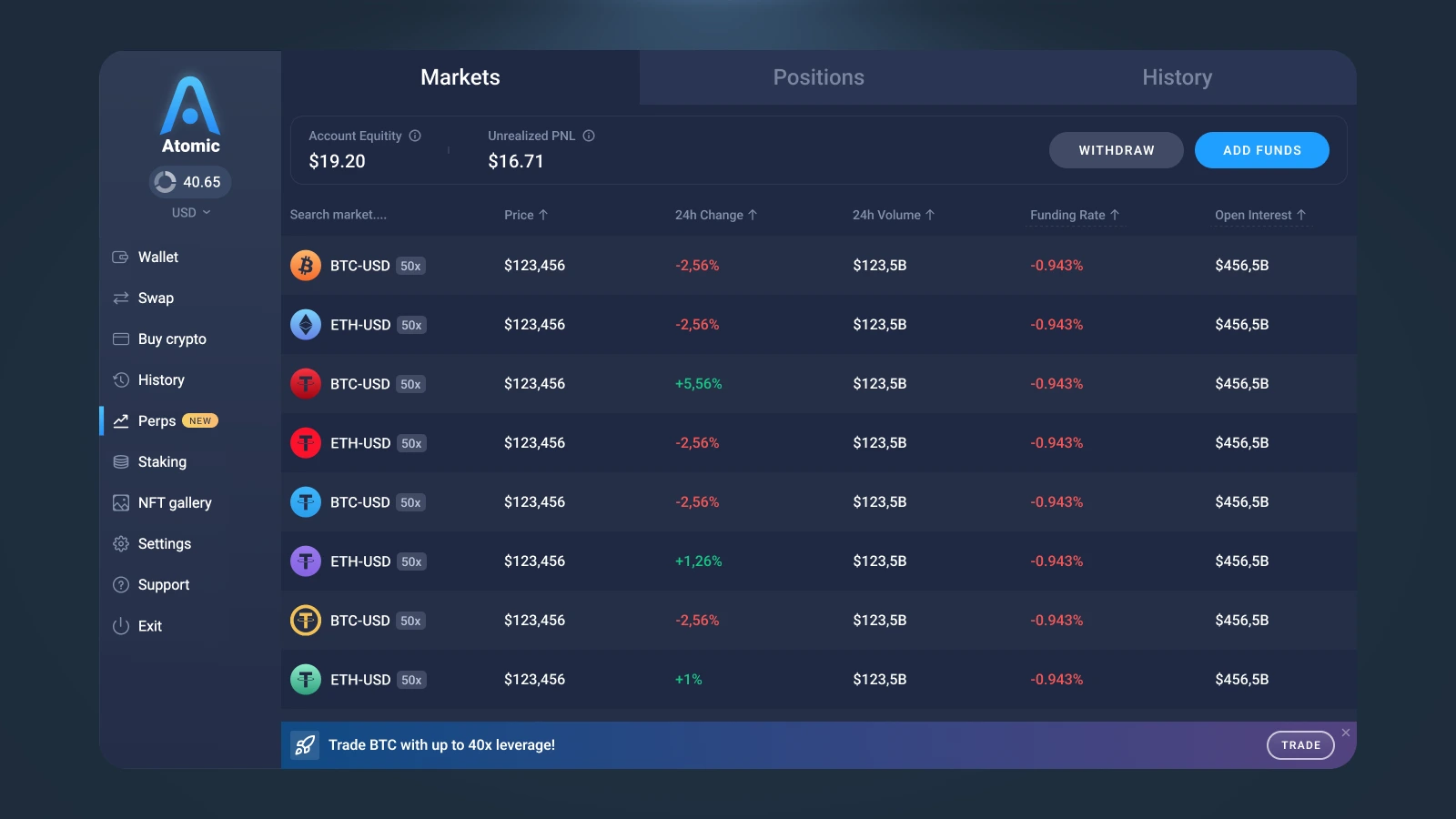
For users who want exposure to this trend through a simpler interface, Atomic Wallet’s Perps trading offers another route into leveraged crypto markets without turning the whole experience into infrastructure management.
Risks of Using Hyperliquid
Hyperliquid removes some problems of centralized futures trading, but it does not remove risk. It changes the risk profile.
The main risks are worth separating clearly:
- Leverage risk: perpetual futures can liquidate positions quickly when the market moves against the trader. This is not unique to Hyperliquid, but it is the core risk of perps.
- Liquidity risk: major markets may be active, but thinner pairs can still suffer from slippage or weaker depth.
- Infrastructure risk: Hyperliquid is not just a front-end. It runs its own trading-focused system, so performance and reliability depend on that stack.
- Self-custody risk: users control access to funds, which also means mistakes, wallet issues, or poor key management are their responsibility.
- Market risk: perps are fast, volatile, and often narrative-driven. Execution speed helps, but it does not replace risk management.
The right way to look at Hyperliquid is not “safer than a CEX” or “riskier than DeFi.” It is a different model. Traders get more control, but they also take on more responsibility for how they trade, manage wallets, and handle leverage.
Why Hyperliquid Matters for the Future of Trading
Hyperliquid is not important because it is “another exchange.” It matters because it shows a direction the market is moving toward.
For a long time, the structure was clear:
centralized exchanges for trading, on-chain products for everything else. That separation is starting to break. Traders want the same execution they are used to, but without being fully dependent on a single platform holding their capital.
Hyperliquid is one of the first systems to push that idea seriously: keep the trading layer intact, move the control layer back to the user. It is not perfect, and it is not the final form, but it makes the shift visible.
This is where the broader trend connects. Perpetual futures are not going away. Self-custody is not going away. The question is how these two meet in a way that is actually usable. Hyperliquid is one answer.
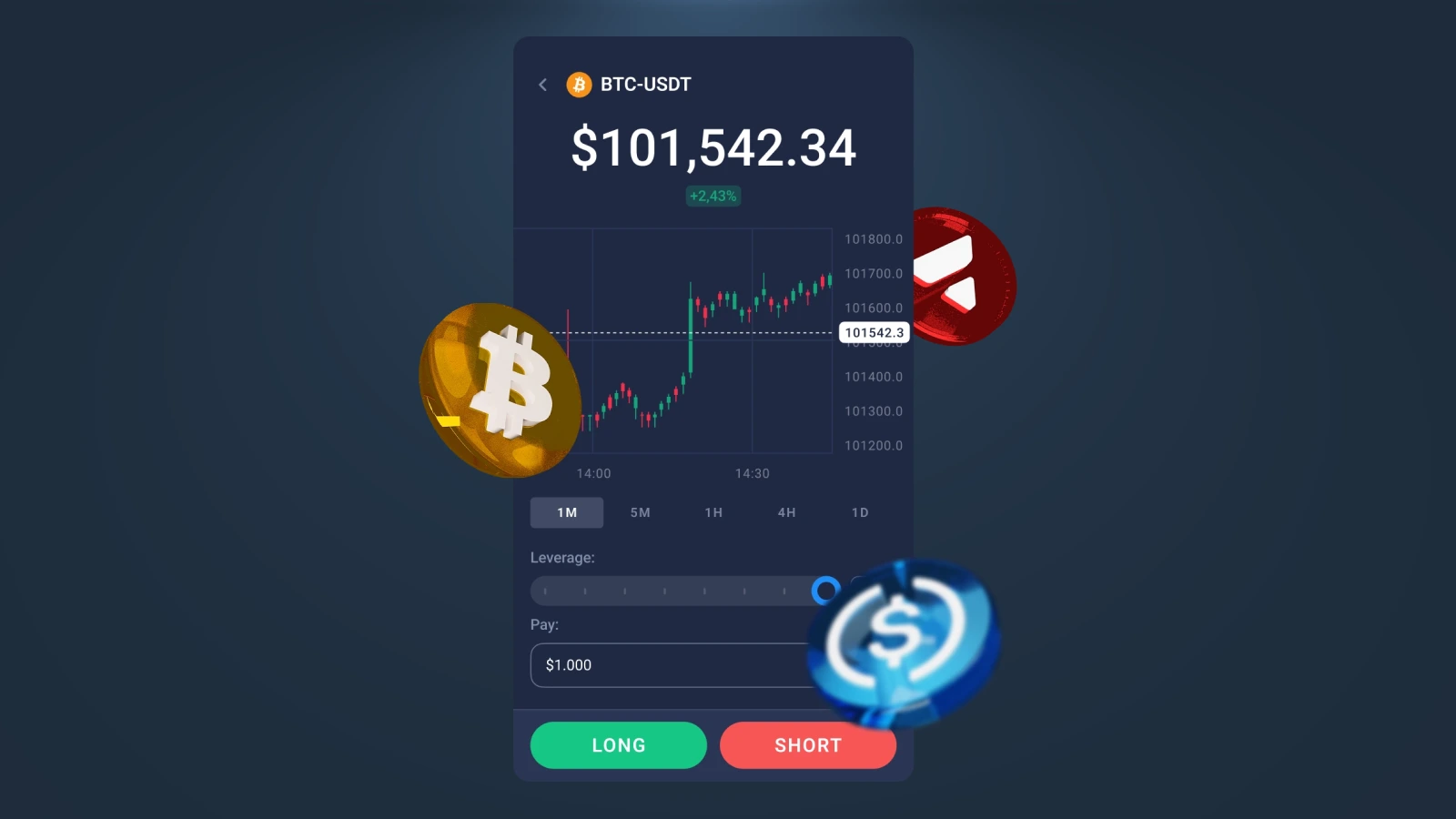
Simpler access layers, like Atomic Wallet’s Perps trading, are another — aimed at users who want exposure to the same markets without dealing with the full complexity of trading infrastructure.
Conclusion: A New Model for Futures Trading
Hyperliquid is best understood not as a standalone product, but as part of a transition.
It keeps the core of what traders need — leverage, order books, fast execution — and changes the layer that has always been taken for granted: custody. That shift alone is enough to redefine how trading platforms are built.
At the same time, it also highlights a gap. Infrastructure can move fast, but most users do not want to manage that complexity directly. They want access, not overhead.
That is where the next stage develops. On one side, platforms like Hyperliquid push the limits of what on-chain trading can do. On the other, products that simplify access make those markets usable for a broader audience.
The direction is clear: futures trading is becoming more open, more flexible, and less dependent on centralized custody.