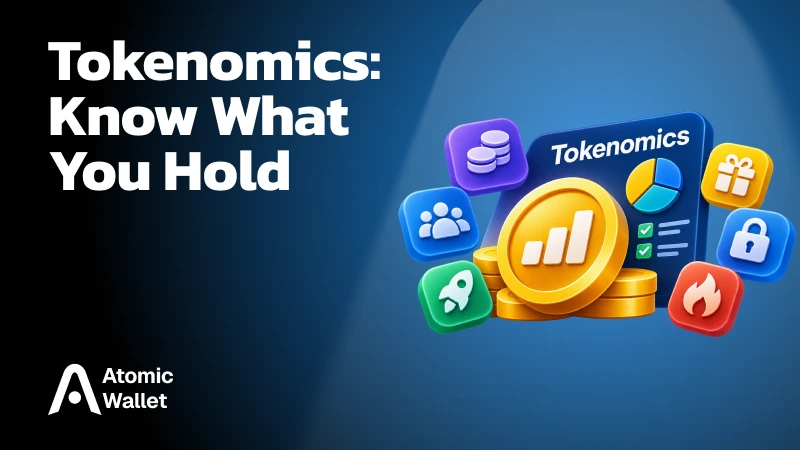
What Is Tokenomics? Definition, Examples, and How It Works
A token priced below $0.01 can have a larger market cap than one trading at $100. To understand the difference, you need to look at how many tokens exist, who holds them, and how their supply could change.
Tokenomics connects those details with the reasons people use and hold an asset. Understanding it helps you ask better questions before buying, swapping, or staking crypto.
What Is Tokenomics?
Tokenomics is the economic design of a cryptocurrency, covering its supply, distribution, uses, and the incentives that reward participants.
The word combines token and economics. Despite the name, it also applies to native coins such as Bitcoin and Ether, alongside tokens issued on existing blockchains.
A project’s tokenomics can specify how new units enter circulation, how much goes to early investors, when team allocations unlock, and where staking rewards come from. It also explains the asset’s role: paying transaction fees, securing a network, accessing services, or voting on proposed changes.
Together, these rules shape the incentives to earn, use, hold, or sell the cryptocurrency.
Why Does Tokenomics Matter?
Tokenomics helps you understand how changes in supply, distribution, and incentives could affect a cryptocurrency you hold.
Your balance can stay the same while more tokens enter circulation, reducing your share of the circulating supply. Early investors may gain access to previously locked allocations. A rewards program may attract users by distributing tokens from a reserve that will eventually run out.
These changes matter even when the product itself keeps growing. More users or transactions do not automatically create demand for its token: that depends on how the asset fits into the system.
Understanding tokenomics helps you assess questions that a price chart cannot answer:
- How quickly could the available supply grow?
- Who will receive those tokens, and when?
- Does using the product require its token?
- How does the network fund participation over time?
The answers provide context for comparing assets and understanding their risks. They cannot establish whether a token will rise in price.
Token Supply: Circulating, Total, and Maximum
Circulating supply measures tokens available to the public, total supply counts existing tokens minus burns, and maximum supply is the stated ceiling on how many can exist.
Each figure answers a different question:
Suppose a project has created 1 billion tokens, but only 100 million qualify as circulating. Its total supply is 1 billion, while its circulating supply is 100 million. The remaining tokens could include locked team allocations, investor holdings, or ecosystem reserves.
If that project also has a maximum supply of 1 billion, all tokens have already been created. Future unlocks could increase circulation without creating additional tokens.
A supply cap also does not mean supply has stopped growing. Bitcoin has a limit of approximately 21 million BTC, but mining continues to introduce new coins. Conversely, an asset without a maximum supply can follow a predictable issuance schedule.
Check the methodology behind supply figures when comparing sources. Tokens held by teams, foundations, or other restricted holders may be treated differently, so “unlocked” and “circulating” are not always interchangeable.
Market Cap vs. FDV: A Tokenomics Example
Market capitalization values a token’s circulating supply at its current price. Fully diluted valuation, or FDV, applies that price to a broader supply figure, typically total or maximum supply depending on the data provider.
Consider a hypothetical token with these figures:
Here, total and maximum supply are equal, so either FDV calculation produces the same result. For other assets, those figures can differ. Check which supply a platform uses before comparing valuations.
The gap tells you that much of this token’s supply sits outside current circulation. To understand the implications, you still need to investigate who controls those tokens, when they become available, and how they might be used.
FDV is a hypothetical valuation at today’s price. It does not predict what the entire supply will eventually be worth. Likewise, a $100 million market cap does not mean buyers have invested $100 million into the asset or could sell the circulating supply for that amount.
Low circulating supply has been a recurring feature of token launches. In its Q2 2024 report, CoinGecko examined 22 newly launched projects: 20 started trading with less than 20% of their supply circulating, while the sample’s average launch FDV was $4.7 billion. The figures illustrate how a relatively small tradable supply can sit behind a much larger headline valuation.
Token Allocation, Vesting, and Unlocks
Token allocation determines who receives tokens, while vesting and unlock rules determine when recipients can access or transfer them.
These details help explain how ownership and the available supply could change after launch.
Who Gets the Tokens?
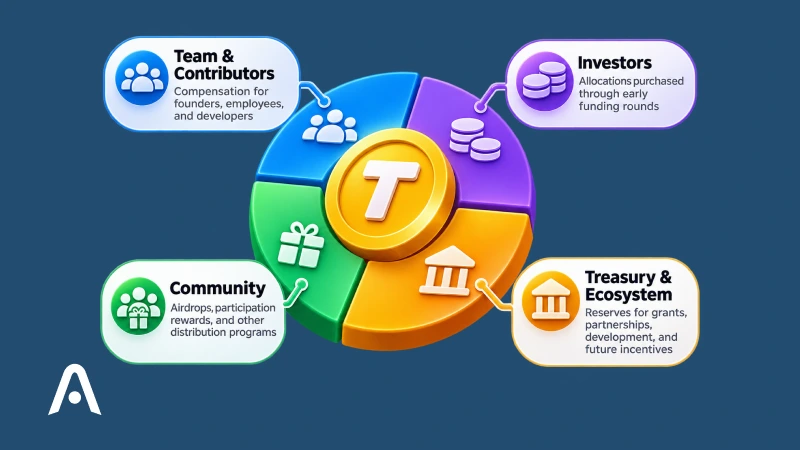
Projects commonly allocate tokens to several groups:
- Team and contributors: Compensation for founders, employees, and developers
- Investors: Allocations purchased through early funding rounds
- Community: Airdrops, participation rewards, and other distribution programs
- Treasury and ecosystem: Reserves for grants, partnerships, development, and future incentives
Look beyond the category names. A “community” allocation might remain under a foundation’s control until it is distributed. A large treasury may fund years of development, but its spending rules and decision-makers still matter.
There is no universal allocation split that makes every project sustainable or decentralized.
Uniswap’s September 2020 launch shows why allocation and immediate distribution are different. Its community allocation represented 60% of the initial UNI supply, while 15% was immediately available to claim across eligible groups. Qualifying user addresses could claim 400 UNI each—including roughly 12,000 addresses that had only submitted failed transactions. The allocation percentage alone would not reveal those distribution details.
How Do Token Unlocks Work?
Vesting restricts access to an allocation until specified conditions are met. Common arrangements include:
- Cliff vesting: Tokens remain locked until a specified date, when some or all become available
- Linear vesting: Tokens become available gradually over a defined period
- Combined schedules: An initial cliff followed by gradual releases
Return to our example: 100 million tokens circulate, with total and maximum supply both at 1 billion. An upcoming unlock of 20 million tokens equals 2% of maximum supply, but 20% of the current circulating supply.
That comparison makes the release easier to assess. Next, check who receives the tokens and whether they become eligible to count as circulating.
Unlocking existing tokens does not create new ones. It also does not establish that recipients will sell. The potential market impact depends on their decisions, demand, liquidity, and how much of the event traders have already anticipated.
Token Utility: What Creates Demand?
Token utility describes what an asset lets people do. Demand can arise when users need to acquire or hold it to pay fees, secure a network, access services, or participate in governance.
Common uses include:
- Transaction fees: Paying to transfer assets or interact with applications
- Network security: Staking tokens to help validate transactions
- Access: Holding or spending tokens to use particular services or features
- Governance: Voting on proposals that affect a protocol or its treasury
The connection between product usage and token demand deserves a closer look. Can users access the service without buying the token? Are fees paid in another asset? Does receiving a reward create a reason to keep holding it?
Governance rights also need context. Check what holders can actually decide and whether voting power is concentrated among a few participants.
A useful product can generate substantial revenue without distributing it to token holders. Holding its token does not automatically provide equity, dividends, or a claim on that revenue. Any mechanism that directs fees toward holders, staking rewards, or token purchases needs to be checked against the project’s current rules.
Inflation, Burns, and Staking Rewards
Issuance adds tokens to supply, burns permanently remove them, and rewards distribute tokens to participants. Their combined effect helps determine how the supply and each holder’s proportional position change.
How Minting and Burning Change Supply
Minting creates new tokens. Depending on the network, issuance may fund mining rewards, validator rewards, or other incentives.
Burning permanently removes tokens from supply. To understand the net change, compare how many tokens are created with how many are burned over the same period. A network with a burn mechanism can still have growing supply when issuance exceeds destruction.
A buyback is different: a project purchases tokens from the market. Those tokens might be burned, held in a treasury, or distributed later. Check what happens after the purchase before treating a buyback as a permanent supply reduction.
Neither a supply cap nor a burn mechanism guarantees price appreciation. Demand and market conditions still matter.
Where Do Staking Rewards Come From?
Rewards may be funded through:
- New issuance: Newly created tokens distributed to participants
- Network fees: Payments collected from users
- Existing reserves: Tokens allocated earlier to a treasury or incentive program
The funding source affects how the rewards influence supply and how long the program can continue. Distributing existing reserves can increase circulation without increasing total supply.
Compare your balance growth with supply growth over the same period. If your balance increases by 15% while total supply increases by 10%, your share of total supply grows by approximately 4.5%.
Your dollar return still depends on the token’s price. When reviewing a quoted yield, also check validator commissions, service fees, payout conditions, and whether the rate is variable or temporarily subsidized.
Tokenomics Examples: Bitcoin, Ethereum, and Arbitrum
Bitcoin, Ethereum, and Arbitrum illustrate three different tokenomics models: capped issuance, variable supply shaped by issuance and burns, and a governance token whose distribution affects participation and control.
Bitcoin’s cap makes its long-term issuance predictable, but it does not establish a future price. Each halving reduces the block subsidy; miners also receive transaction fees.
Ethereum shows why “no maximum supply” does not mean unlimited issuance at an arbitrary rate. Its protocol governs both creation and burning, and the net result depends on staking and transaction activity.
ARB highlights a different question: does using the network require its governance token? On Arbitrum One and Nova, transaction fees are paid in ETH. ARB holders participate in governance, so assessing the token requires examining those rights alongside distribution.
How to Evaluate a Crypto Token’s Tokenomics
Evaluate tokenomics by checking the project’s rules, supply, distribution, upcoming releases, actual uses, and reward funding against official documentation and current data.
Work through these checks in order:
- Find the official documentation: Locate the tokenomics page, whitepaper, and relevant governance decisions, checking whether later changes have replaced the original model
- Compare supply figures: Record circulating, total, and maximum supply, then confirm which figure the data provider uses for FDV
- Examine allocation and control: Identify team, investor, community, and treasury holdings, including who controls undistributed reserves
- Review upcoming unlocks: Check dates, recipients, and release sizes relative to current circulation, distinguishing existing locked tokens from future issuance
- Verify the token’s role: Establish what users need it for and whether any advertised revenue-sharing or buyback mechanism is already active
- Trace rewards and rule changes: Identify whether payouts come from issuance, fees, or reserves, and who can change supply or distribution rules
Treat holder rankings carefully. One exchange or staking address may represent many users, while one owner can control multiple addresses. A list of large wallets needs context before it can reveal ownership concentration.
What Makes Good Tokenomics?
Good tokenomics fits the system it supports, with understandable rules and incentives that can sustain necessary participation.
Useful signs include:
- Clear supply and release schedules that match the project’s published rules
- A defined role for the token within the product or network
- Transparent control over treasury funds and economic changes
- Reward funding that participants can understand and assess over time
Warning signs include unexplained minting powers, conflicting supply figures, undisclosed unlocks, and high rewards with no clear funding source.
There is no ideal allocation percentage or FDV ratio for every project. Assess the model as a whole, alongside security, liquidity, adoption, and market conditions.
Manage Your Crypto With Atomic Wallet
Atomic Wallet lets you store supported cryptocurrencies, exchange assets, and stake eligible coins in one app.
Once you understand an asset’s supply, utility, and distribution, you can make more informed decisions about how to use it. When exploring staking options in our wallet, check the network’s reward model, fees, and withdrawal conditions alongside the displayed yield.