What Is USDT? How Tether Works and What It’s Used For
USDT, also called Tether, is a cryptocurrency designed to stay close to $1 per token. If you see 100 USDT in a crypto wallet, that balance is usually worth about $100.
People use USDT to buy and sell other cryptocurrencies, send money between wallets, and pay businesses that accept it. Its appeal is simple. You can move money on a blockchain while keeping track of what it’s worth in dollars.
What Is USDT?
USDT is a cryptocurrency issued by Tether and designed to trade close to one U.S. dollar per token.
USDT is the ticker for Tether’s U.S. dollar token, which the issuer also writes as USD₮. It belongs to a category of cryptocurrencies called stablecoins. A stablecoin aims to track a reference asset. For USDT, that reference is the U.S. dollar.
Tether first issued USDT in 2014 on Omni Layer, a protocol built on Bitcoin. Today, USDT is available on multiple blockchains, including Ethereum, TRON, and Solana. Each version has the same dollar target and moves on its own network.
How Does USDT Stay Close to $1?
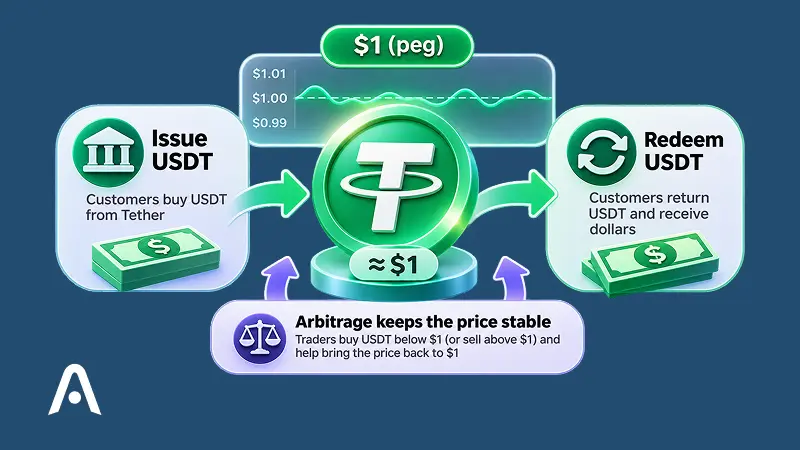
Tether’s reserves support direct redemption, and arbitrage helps keep the market price of USDT close to $1.
Tether issues USDT into circulation when eligible customers buy it directly. When those customers redeem USDT, Tether takes the tokens out of circulation and pays their dollar face value, minus applicable fees.
On exchanges, the price can move slightly above or below $1. If USDT trades below $1, a trader with direct access to Tether can buy it at a discount and redeem it for dollars if the difference covers the costs. Those purchases create demand that helps bring the market price back toward $1.
Tether requires account verification and sets a $100,000 minimum for direct purchases and redemptions. The redemption fee is the greater of $1,000 or 0.1% of the amount. People exchanging smaller amounts typically use a platform with its own rates and fees.
USDT vs. USD
USD is the U.S. dollar, which you can hold as cash or in a bank account. USDT is a token that tracks the dollar and moves between blockchain addresses. To turn a USDT balance into dollars in your bank account, you typically sell it through a service that supports bank withdrawals.
What Is USDT Used For?
People use USDT to trade cryptocurrencies, transfer funds between wallets and exchanges, and pay businesses or individuals who accept it.
- Trade crypto. A pair like BTC/USDT lets you buy or sell bitcoin against a token that tracks the dollar
- Transfer funds. You can send USDT to another wallet or exchange when both sides support the same network
- Pay for goods or services. A merchant or freelancer can quote a price in USDT and provide the details needed to pay
Tether reported $3.2 trillion in spot trading volume involving USDT on centralized exchanges in Q4 2025. USDT was the quote currency in 96.5% of that volume, meaning traders used it to express the price of another asset.
What Is a USDT Payment?
Suppose a freelancer sends you an invoice for 100 USDT on TRON. The invoice gives you the amount, the network, and a receiving address. In your wallet, select USDT on TRON, enter the address and amount, then review the transaction fee before confirming.
If you pay from an exchange, check how much the recipient will receive after the withdrawal fee. An invoice for 100 USDT may remain unpaid if the recipient receives less. For an online checkout, wait for the payment status to update after the required blockchain confirmations.
What Network Is USDT On?
USDT is available on several blockchains, including TRON, Ethereum, and Solana. For a transfer, the receiving wallet or exchange must support the version you send.
Start with the network shown on the recipient’s deposit screen or invoice. Then check that the sending wallet or exchange offers that same network for USDT. The ticker identifies the asset, while the network determines where the transfer arrives.
What Is TRC-20 USDT?
TRC-20 USDT is the version of Tether that runs on TRON. For the 100 USDT invoice on TRON, you need a TRC-20 USDT balance if you’re paying from your own wallet. Check the fee preview before confirming so you know whether you also need TRX.
If you’re paying from an exchange, look for TRON or TRC-20 in its withdrawal options. The exchange sets its own withdrawal fee, which can differ from what the blockchain charges for the transaction.
In October 2026, TRON DAO reported that more than 94 billion USDT was circulating on TRON, the largest USDT supply on any single blockchain.
What Backs USDT?
Tether backs USDT with a portfolio of reserve assets. U.S. Treasury bills made up the largest category in its September 2026 report.
Tether’s reserve report, published October 30, 2026, lists the following figures as of September 30.
About 73% of reserve assets fell into the report’s category for cash, cash equivalents, and other short-term deposits. That category included $122.84 billion in U.S. Treasury bills as well as reverse repurchase agreements. The report also listed $19.08 billion in precious metals, $8.37 billion in bitcoin, and $14.18 billion in secured loans as separate categories.
The composition matters because different assets behave differently under stress. Short-term Treasury bills can generally be sold quickly, while the value of bitcoin and precious metals can fluctuate. Both the size and the makeup of the reserves matter when assessing Tether’s ability to meet redemptions.
BDO’s quarterly assurance report covers the reserve figures at a specific date. Separately, Tether announced in August 2026 that KPMG U.S. had completed an audit of Tether International’s annual financial statements for the year ended December 31, 2025.
Is USDT Safe?
USDT is designed to trade near $1, but holding and sending it still involves market, issuer, and transfer risks.
The market price can fall below $1. USDT traded below its target during the May 2022 market turmoil. If you need to sell, check the actual quote and fees on your platform to see how much you’ll receive.
Tether can freeze USDT at specific addresses. In November 2026, Tether said it froze more than $1.5 billion in USDT following the Binance hack. Self-custody gives you control of your wallet keys, while restrictions imposed through the token contract can still affect your balance.
A confirmed transfer can go uncredited. If you send USDT over a network the receiving exchange doesn’t support, the blockchain may confirm the transfer while the deposit stays missing from your account. Use the transaction ID to verify the network and ask the receiving platform whether it can recover the deposit.
USDT vs. USDC
USDT and USDC both aim to track the U.S. dollar. They differ in who issues them, how their reserves are managed and reported, and which networks your platform supports for each token.
For a payment, use the token and network the recipient specifies. If both are accepted, compare the total cost of getting the payment there, including any swap, withdrawal, or network fees.
Manage USDT With Atomic Wallet
You can hold, receive, and send USDT on supported networks with Atomic Wallet.
To receive USDT, open the version of the token you want to use in our wallet, select Receive, and copy the address shown. If you’re withdrawing from an exchange, choose the same network there. For a transfer on TRON, follow our guide to sending and receiving TRC-20 USDT.